Women, minority small business owners confused, worried after Texas kicks them off HUB program
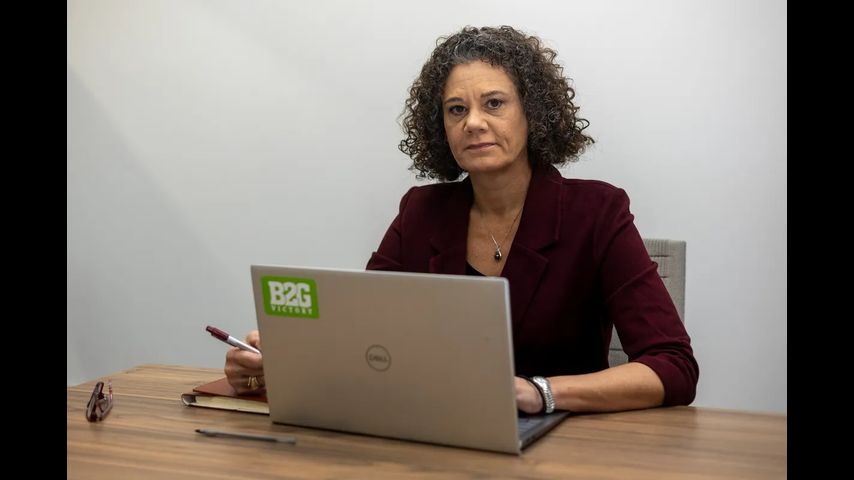
Julie Irvin Hartman started her Tuesday with welcome, but confusing news.
The application she had submitted weeks ago to renew her business’s certification as a Historically Underutilized Business had been approved, despite acting state Comptroller Kelly Hancock’s late October announcement that he was freezing the program intended to give businesses owned by women, minorities and disabled veterans a boost when seeking state government contracts.
But hours later, the comptroller’s office emailed Hartman again, notifying her and more than 15,000 other small businesses — nearly 97% of the certified HUB businesses in Texas — that they were being removed from the HUB program entirely.
Then her phone notifications exploded.
The owner of Tomball-based B2G Victory, Hartman has built her business around advising other small businesses about how to navigate the world of government contracting, making her the first call for many of her confused clients who also received the comptroller’s email.
“I’m the expert in this space and I’m charging expert fees, and telling people, ‘I don’t know,” Hartman said. “So what value am I providing? It’s tough right now … I’ve had a lot of sleepless nights.”
Hartman and thousands of other HUB-certified businesses have faced uncertainty since Hancock first announced the freeze of the decades-old program, arguing that it may run afoul of both the state and U.S. constitutions, without pointing to any specific violation. No state or federal judge has ruled the program unconstitutional.
The program launched in the 1990s and is administered by the Comptroller’s office, which certifies HUB businesses that can show a majority of their ownership is “economically disadvantaged” people — including women, Black Americans, Hispanic Americans, Asian Pacific Americans, Native Americans and service-disabled veterans.
The bipartisan state law that created the program doesn’t mandate that HUB-certified businesses are granted state contracts, but sets goals that state agencies are encouraged to meet.
Hancock said it was necessary to freeze and review the program to ensure it complies with Gov. Greg Abbott’s January executive order banning programs that promote “diversity, equity and inclusion” from state agencies. Then the Comptroller’s office announced Tuesday that the HUB program will now only be available to small businesses controlled by veterans with a 20% percent or higher service-connected disability.
That decision excludes the vast majority of the previously HUB-certified businesses while maintaining the status quo for 485 disabled veteran-owned businesses, according to a May comptroller’s report. All 485 are owned by men, according to the report.
“Our nation’s veterans have always stepped up for us,” Hancock wrote in a statement Tuesday. “VetHUB is Texas’ way of stepping up for them — cutting red tape, restoring constitutional integrity and opening doors for the men and women who wore our nation’s uniform. These emergency rules ensure Texas’ state contracting is free from gender or race discrimination and keep the program centered on those who earned this support through their service.”
A frequently asked questions page on the Comptroller’s website assured HUB businesses with current government contracts that those agreements would be honored for the duration of the contract.
Garry Olson, owner of Austin-based IT solutions company Semper Feye Solutions and a service-disabled veteran, had spent weeks fretting over the possibility of losing his ongoing state contracts if the HUB freeze did not end before his certification expires in February.
“I have heard that there were issues with the program before, but I’ve never had any problems with it,” Olson said. “I was thankful to be a part of it, and I’m thankful to still be a part of it.”
Efforts to kill HUB program failed in Legislature
State Sen. Royce West, a Dallas Democrat who co-authored the 1999 bill that created the HUB program, said it’s a necessary tool to correct historical discrimination in government contracting.
"Black businesses, Hispanic businesses, women-owned businesses, all the other categories in the HUB statute were not able to have meaningful participation for procurement opportunities with the state," West said. "Recognizing quotas would be illegal, we put together a good faith program to look at whether or not agencies are making good faith efforts to bring in those categories that have been historically discriminated against."

Several Republican bills aimed at killing the HUB program entirely were filed earlier this year in the Legislature. They all died without making progress in either chamber.
West disputed Hancock’s ability to alter the HUB program in such a significant way without the approval of the Legislature.
“If we allow an officer not associated with the legislative body that passed the law signed by the governor to do this to this program, what else will they attempt to do that is outside the scope of their statutory authority?” West said.
Companies scrambling to adjust without HUB
Kate Kossack’s staffing agency, Cedar Park-based HireOps Staffing, was HUB-certified as a woman-owned business and is a subcontractor on a state contract in the health care field. She credited the HUB program with her success winning government contracts soon after starting her business in 2016 and said she believes the Comptroller’s decision will cause her business to lose money.
“In staffing, it’s hard to compete with bigger firms … Not having restrictions from the state will open the door to let (larger companies) do absolutely whatever they want,” Kossack said. “We could just be left in the dust.”
Helen Callier, who owns Kingwood-based BradLink LLC, a HUB-certified architectural design and project management firm, said she knows she will still be able to find work despite losing her HUB status, but her company will have to make changes. Many companies use their HUB certification as a marketing tool, but now they will have to find other ways to attract customers, she said.
“I know some folks that are sweating because they see their certification as the only means of doing business at the state level,” Callier said. “The bottom line is that’s not the case, but you have to suit up and go after it now.”
Hartman, the government contracting adviser, said losing her HUB status is unlikely to put her out of business, but she saw her revenue drop after the Comptroller’s office froze the program.
Hartman’s company is paid by procurement offices and chambers of commerce to host seminars explaining the certification process to other small businesses, and she said many of them have been canceled since the freeze began. Clients have hesitated to renew their contracts with her company after the freeze began, she added, and the company stands to lose as much as 25% of its annual revenue this year alone.
As she fields calls from confused clients and works to interpret the latest guidance from the Comptroller, Hartman has spent the past week driving back and forth between the Houston area and Austin as she moves her father into hospice care.
“I’m having to make a decision between what’s right for my industry, what’s right for my company, what’s right for my clients and what’s right for me as a daughter being there for my family,” Hartman said. “I’ve been an entrepreneur for 23 years … this has been the hardest year.”
This article first appeared on The Texas Tribune.
More News