Texas high school students are applying for college financial aid at a record pace
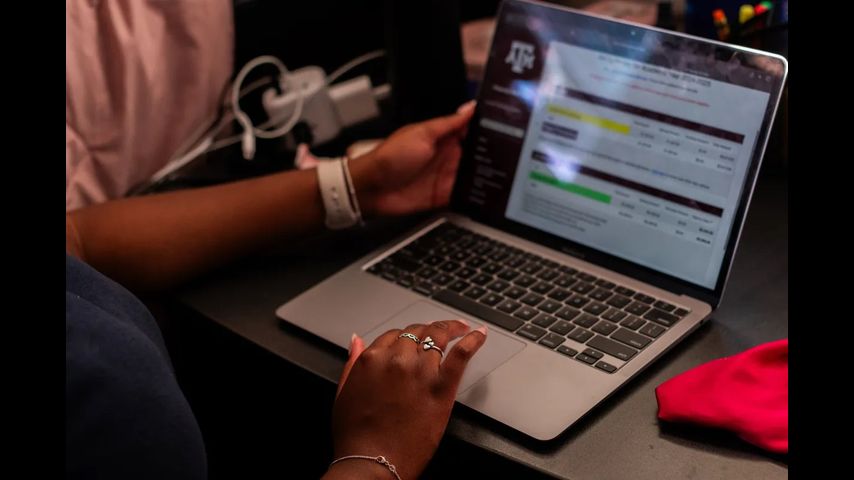
Texas is on track to see a record number of students complete the federal form to request financial aid for college, a critical step in applying to and affording college.
But for students who have at least one undocumented family member, applying for federal financial aid at a time of heightened immigration enforcement means weighing the risk of sharing family information with federal officials. Financial aid applications are protected by student privacy laws, but college access advocates say such reassurances are often not enough, prompting some students to reconsider college altogether.
So far, nearly 60% of high school students in Texas have completed the financial aid form, an all-time high for this point in the year, according to National College Attainment Network data. That’s about an 8 percentage point increase from last school year.
“I would be stunned if Texas does not hit an all-time high by June 30 of this year. This is substantial,” Bill DeBaun, senior director of data and strategic initiatives at the National College Attainment Network.
The federal deadline to submit the form is June 30, although Texas recommends students apply before Jan. 15 to get priority consideration for state grants.
Completing the FAFSA — the primary way to get federal, state and school financial aid — is a strong predictor of whether a student goes to college. The Texas high school class of 2024 missed out on $550 million in Pell Grant money alone by not submitting the FAFSA, the Free Application for Federal Student Aid.
Texas has consistently had one of the country’s highest completion rates since graduating high school students were required to complete the FAFSA beginning in 2021. Parents also are getting the message that FAFSA is expected for high school graduation, which can encourage them to fill out their part of the form. Students have an option to sign an opt-out form or complete the Texas Application for State Financial Aid if they are ineligible for the FAFSA.
Community colleges and universities in the state have also recently expanded or launched “free tuition” campaigns, known as promise programs, that depend on students filling out the FAFSA. These promise programs are often set up so colleges cover the tuition for low-income students after federal and state grants are applied.
Advertising campaigns touting free tuition are likely driving up the completion rate of FAFSA in Texas, said Sara Urquidez, executive director of the Academic Success Program, which provides college advising to low-income students in Dallas, Houston and College Station,.
The latest jump in FAFSA submissions in Texas, which aligns with a nationwide trend, can also be attributed to the revamped form. After a bungled rollout in 2024, students are typically completing the form much faster, and the process to get a FAFSA ID verified is almost instantaneous, DeBaun said.
“The FAFSA revamp was supposed to deliver a quicker, easier form, and it looks like it has,” DeBaun said. “When practitioners are doing financial aid nights, they only need to get one bite at the apple with students. … You're not having someone show up, [set up] the FAFSA ID and then say, I need to come back in two, three, four days.”
Despite overall gains, college access advisers say students from immigrant families are increasingly afraid the information they submit in the FAFSA could be used to deport their family members.
The immigration crackdown “trickles down to any student being comfortable disclosing either their information, their parents’ information, their statuses,” said Brenda Gonzalez of ImmSchools, a group that supports undocumented and mixed-status families across Texas. “It does heighten the hesitation, the hesitation of should I do this? How safe is it for me? How safe is it for my family?”
At Breakthrough Central Texas, college advisers tell families that FAFSA data is protected by a federal student privacy law known as FERPA, and that they know of no instances of federal financial form data being used for immigration enforcement. Urquidez at the Academic Success Program reminds families who have filed tax forms or the FAFSA in previous years that submitting the FAFSA this year won’t provide officials information they don’t already have.
But Urquidez also recognizes the hesitation around FAFSA comes as the path to higher education is narrowing for immigrant families. She sees her students make careful choices about which colleges to attend based on how safely they can attend class without risking deportation. Last year, Texas retracted in-state tuition for undocumented students.
“We're talking a lot more about students sitting out for a year and seeing if the political climate gets a little bit better,” Urquidez said. “It's hard because I worry for them. We know, just based on precedent, that students who sit out at this point don't usually have the opportunity to go back.”
The Texas Tribune partners with Open Campus on higher education coverage.
This article first appeared on The Texas Tribune.
More News