Trump meets Mexican President Sheinbaum in person for the first time at World Cup draw
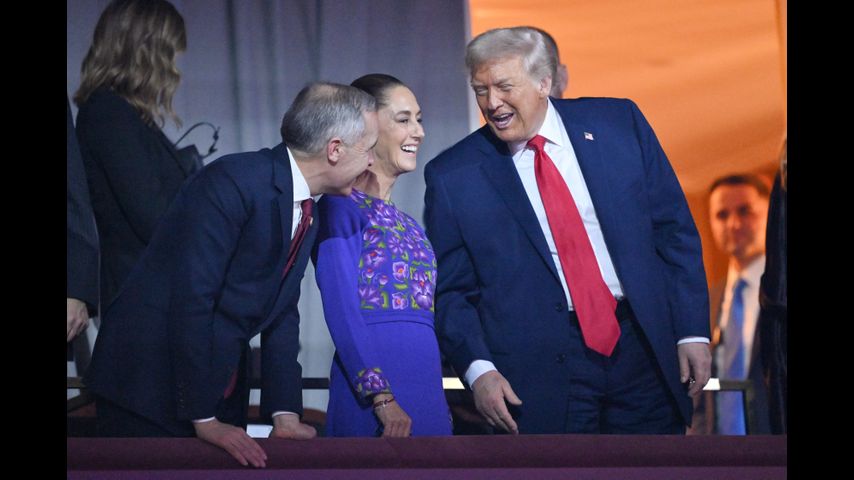
WASHINGTON (AP) — President Donald Trump has finally met with his Mexican counterpart, Claudia Sheinbaum.
Their long-delayed first face-to-face discussion focused on next year's World Cup — and included side discussions about trade and tariffs — but immigration was not the top issue. That's despite Trump's push to crack down on the U.S.-Mexico border being his centerpiece issue, and the driving force in the relations between both countries.
Trump has been in office for more than 10 months, and his taking so long to see Sheinbaum in-person is striking, given that meeting with the leader of the country's southern neighbor is often a top priority for U.S. presidents.
Trump and Sheinbaum had been set to meet in June on the sidelines of the Group of Seven summit in Canada, but that was scrapped after Trump rushed back to Washington early amid rising tensions between Israel and Iran.
Soccer took center stage — but tariffs still loom large
Trump and Sheinbaum sat talking in the president's box and also appeared onstage with Canadian Prime Minister Mark Carney at the Kennedy Center for Friday's 2026 World Cup draw. The U.S., Mexico and Canada are co-hosting the tournament, which begins in June.
Sheinbaum said before leaving Mexico that she planned to attend the draw and that she and Trump would likely meet briefly after it. She said she'd talk to him about tariffs that Trump's administration has imposed on automobiles, steel and aluminum from Mexico — among other things.
Trump said upon arriving at the draw that he was set to meet with Sheinbaum.
Mexico is the United States' largest trading partner. And, though the North American trade pact Trump forged in his first term, the U.S.-Mexico-Canada Agreement, is still in place, U.S. Trade Representative Jamieson Greer has begun scrutinizing the agreement ahead of a joint review process due in July.
In the meantime, the U.S. and Mexico's priorities have been reshaped by the steep drop in the number of people crossing into the U.S. illegally along its southern border, as well as the White House's — so far largely unrealized — threats to impose large trade tariffs on its neighbor.
Trump and Sheinbaum have often spoken by phone to discuss tariffs and Mexican efforts to help combat the trafficking of fentanyl into the U.S. But despite other world leaders, including Russian President Vladimir Putin and Chinese President Xi Jinping, having already met with Trump this term, the meeting with Sheinbaum has been delayed until now.
The Trump whisperer?
Waiting so long to meet in person hasn't seemed to hurt Mexico's president's standing with Trump.
The two spoke by phone in November 2024, with the then-U.S. president-elect declaring afterward that they'd agreed "to stop Migration through Mexico" — even as Sheinbaum suggested her country had already been doing enough.
Trump soon after taking office threatened to impose a 25% tariff on goods imported from Mexico in an effort to force that country to better combat fentanyl smuggling, only to later agree to a pause.
The White House subsequently backed off tariff threats against most Mexican goods. Then, in October, Sheinbaum announced that the U.S. had given her country another extension to avoid sweeping 25% tariffs on goods it imports to the U.S. — even as many items covered by the USMCA trade deal remain exempt.
Sheinbaum's success at managing the bilateral relationship has led some to wonder if she has a special gift for getting what she wants from him. She's largely pulled it off by affording Trump the respect the U.S. president demands from leaders around the world — but especially a neighboring country — and by deploying occasional humor and pushing back, always respectfully, when necessary.
Sheinbaum also defused another potential point of contention, Trump's renaming of the Gulf of Mexico to the "Gulf of America," by proposing dryly that North America should be renamed "América Mexicana," or "Mexican America." That's because a founding document dating from 1814 that preceded Mexico's constitution referred to it that way.
Still, Mexican officials continue to work furiously to stave off more tariffs going into 2026 — levies that could wreck its already low-growth economy — and defend its citizens living in the U.S. as the Trump administration expands its mass deportation operations.
Sheinbaum's government also lobbied hard but unsuccessfully against a 1% U.S. tax on remittances, or money transfers that millions of Mexicans send home every year from the United States. It was approved as part of Trump's tax cut and spending package and takes effect Jan. 1.
Trump's push for mass deportations
Trump has directed federal officials to prioritize major deportation pushes in Democratic-run cities — an extraordinary move that lays bare the politics of the issues. He's also deployed the National Guard in an effort to curb crime, which has led to a spike in immigration-related arrests, in places like Los Angeles, Chicago and Washington, as well as Memphis, Tennessee, and Portland, Oregon.
The Trump administration says its priority is targeting "the worst of the worst" criminals, but most of the people detained in operations around the country have not had violent criminal histories.
That often has meant targeting Mexican citizens who have lived and worked in the United States for years and may face deportation to a homeland they no longer know well. It also has meant serious threats of declining remittance income, which has fallen for seven consecutive months.
The lower number of illegal U.S.-Mexico border crossings has knocked immigration off its perch as the top agenda item for the U.S.-Mexico bilateral relations for the first time in recent memory.
Mexican officials now say conversations around immigration have shifted toward cajoling countries into taking back their citizens and reintegrating them to keep them from leaving again — a major Trump administration priority around the world.
Cooperation on security
Sheinbaum has blunted some of the Trump administration's tough talk on fentanyl and drug smuggling cartels by giving her security chief Omar García Harfuch more authority.
Mexico has also extradited dozens of drug cartel figures to the U.S., including Rafael Caro Quintero, long sought in the 1985 killing of a DEA agent. That show of goodwill, and a much more visible effort against the cartels' fentanyl production, has gotten the Trump administration's attention.
That's a significant improvement. Only a few years ago, the DEA struggled to get visas for its people in Mexico, and then-President Andrés Manuel López Obrador accused the U.S. government of fabricating evidence against a former Mexican defense secretary, though he never presented evidence to back up the allegation.
Not everything has gone so smoothly, though. Trump criticized Sheinbaum for rejecting his proposal to send U.S. troops to Mexico to help thwart the illegal drug trade.
Last month, Sheinbaum said there was no way the U.S. military would be able to make strikes in Mexico, after Trump said he was open to the idea. And she has denounced U.S. strikes on boats allegedly carrying drugs in the Caribbean and eastern Pacific.
"The president of Mexico is a lovely woman, but she is so afraid of the cartels that she can't even think straight," Trump said earlier this year.
Sheinbaum declined to take the bait — and avoided turning up the political pressure — by sidestepping Trump's criticism.
___
Associated Press writer Chris Sherman contributed from Mexico City.
More News