Texas lawmakers say colleges have to balance free speech with duty to keep discourse civil
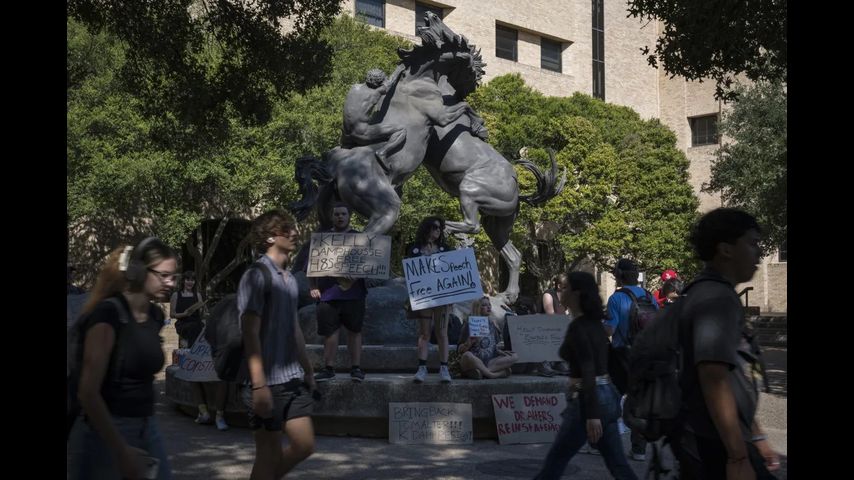
Texas lawmakers on Thursday opened a sweeping review of campus speech with a call to restore civil discourse, saying student reactions to the killing of conservative activist Charlie Kirk exposed deeper problems with intimidation, hostility and uneven responses from universities.
"Freedom of speech is not the freedom of threaten, harass or disrupt," said Rep. Terry Wilson, R-Georgetown. "Academic freedom is not the license to defy public accountability."
Kirk was killed Sept. 10 while speaking at a college in Utah. State leaders announced the formation of bipartisan committees to discuss campus speech and related policies two days later. The Senate and House Select Committee on Civil Discourse and Freedom of Speech in Higher Education convened jointly Thursday at 9:30 a.m. in Austin and heard testimony only from invited speakers.
Sen. Paul Bettencourt, R-Houston, who chairs the Senate panel, said lawmakers wanted to hear from people directly involved in recent campus controversies, such as Devion Canty Jr., a student who says he was forced to withdraw from Texas State University after a video of him appearing to mimic Kirk’s assassination went viral in September.
But Canty ultimately was not invited to testify after the committee saw social media posts indicating he had left Texas “for his own safety.”
According to the committee agenda, lawmakers plan to hear from 11 invited witnesses across three panels. The first panel included University of Texas at Austin President Jim Davis and Texas Higher Education Coordinating Board Commissioner Wynn Rosser.
Wilson, who co-chairs the committee, said future hearings next year will include public testimony.
Davis agreed said UT-Austin will intervene when protests escalate into tearing up signs, blocking events or engaging in what lawmakers described as a "heckler's veto," which is when someone shouts down a speaker.
Davis also took questions about how UT-Austin handles complaints about faculty. Sen. Juan "Chuy" Hinojosa, D-McAllen, raised the issue in light of Texas A&M University's recent firing of English professor Melissa McCoul after she was secretly recorded disagreeing with a student on the legality of teaching gender identity in an exchange was posted on social media. The university says she was fired for not changing her course content to match the description, which McCoul disputes. Hinojosa warned against "knee jerk" disciplinary reactions driven by political pressure.
Davis responded that UT-Austin works to verify facts before taking action.
"We have rules in place to make sure we are protecting people from allegations that are not true, and we are also taking appropriation action when things are true," Davis said.
Sen. Lois Kolkhorst, R-Brenham, pressed Rosser on how the state can enforce long-standing transparency laws, pointing to her 2009 bill requiring syllabi and course information online. She asked what penalties exist when universities do not comply and cited the recent Texas A&M firing as an example of why accurate course descriptions matter. Rosser said he did not have the statute in front of him and could not recall its enforcement provisions.
Lawmakers also invited the regional manager of Turning Point USA, the group Kirk founded; the general counsel of the UT-Austin; a deputy from the Texas Attorney General's Office; and a major from the Texas Department of Public Safety. The Boards of Regents for the Texas A&M, Texas Tech University and University of North Texas systems were holding their quarterly meetings at the same time, which could explain their absence.
The incident with Canty drew statewide attention after Gov. Greg Abbott urged Texas State to “expel this student immediately,” saying that “mocking assassination must have consequences.” A few hours later, the university said Canty was no longer enrolled. Canty told the student newspaper he was given the choice to withdraw or be expelled.
Legal experts have said the behavior seen on video, which was offensive to many, is still likely protected by the First Amendment.
Other incidents tied to reactions over Kirk’s death have also prompted state action. At Texas Tech University, a student was arrested on a misdemeanor charge of simple assault after allegedly striking the cap off a Kirk supporter; the university later confirmed the student is no longer enrolled. At the University of North Texas, Attorney General Ken Paxton launched an investigation after a student said her classmates celebrated Kirk’s killing. Paxton is accusing the university of failing to discipline those involved.
The scrutiny comes amid new data suggesting that many students are open to taking action against speech they disagree with. A national survey released by the Foundation for Individual Rights and Expression on Sept. 9, a day before Kirk’s killing, found that one-third of students said it is at least “rarely” acceptable to use violence to stop a campus speech, and larger shares said it was acceptable to shout speakers down or block access to events.
Before Kirk was killed, lawmakers had already tightened rules around campus expression in response to the pro-Palestinian protests last year. Senate Bill 2972, which took effect Sept. 1, restricts overnight expression, limits amplified sound during class hours and narrows where protests can occur on campus. A federal judge temporarily blocked the University of Texas System from enforcing parts of the law, with the judge saying students were likely to succeed on their claim that the restrictions violate the First Amendment. The UT System is appealing the ruling.
The Texas Tribune partners with Open Campus on higher education coverage.
Disclosure: Texas A&M University, Texas Tech University, University of North Texas, University of Texas System and University of Texas at Austin have been financial supporters of The Texas Tribune, a nonprofit, nonpartisan news organization that is funded in part by donations from members, foundations and corporate sponsors. Financial supporters play no role in the Tribune's journalism. Find a complete list of them here.
This article first appeared on The Texas Tribune.
More News