Texas’ child care quality control measures played a role in enrollment cuts this fall
This article first appeared on The Texas Tribune. The Texas Tribune is a nonprofit, nonpartisan media organization that informs Texans — and engages with them — about public policy, politics, government and statewide issues.
Texas’ child care quality control measures played a role in enrollment cuts this fall
Quality control measures implemented on programs receiving federal Child Care Services have put an even deeper financial strain on the Texas child care system.
Now, thousands of Texas children are shut out of affordable child care as the state struggles to keep the strained program within its budget.
The Texas Workforce Commission in August announced the cost of child care per student on the federal Child Care Services program had risen to more than the program could afford. The program pays for all or part of child care tuition for low-income families. The commission, which administers the program, cut the number of children it would serve statewide by a little less than 10% in 2027. This is expected to add 14,000 names to the more than 100,000 young children already waiting for subsidies.
In a recent report, the Legislative Budget Board pointed to two main reasons for the cost increase in child care subsidies: inflation and more programs that qualified for higher payments.
The number of providers that qualified for Texas Rising Star, which guarantees higher payments to providers per child, more than doubled between 2021 and 2025, according to the Texas Workforce Commission. The largest jump came between 2024 and 2025, when nearly 2,000 new providers qualified for Texas Rising Star. Most of that growth was in the 2 Star category, which is the lowest level of the program. But at the same time, many programs upgraded to Texas Rising Star 3 and 4 — which receive even higher payments than level 2.
This growth is due to a 2021 bill Texas lawmakers passed requiring programs that accept students whose tuitions are paid by subsidies be qualified as Texas Rising Star.
House Bill 2607 was led through the House by state Rep. James Talarico, who is now running as the Democratic candidate for U.S. Senate against Texas Attorney General Ken Paxton. Talarico’s campaign has promised multiple ways to improve child care access and affordability – including nationwide universal child care — and has cited his work as a representative to improve the quality, safety and cost of child care in the state. Implementing this bill improved the quality of child care in Texas and gave parents more control over their child’s care.
“This was a way to make sure that the lowest income children — who are the ones that get subsidies — are in a high-quality program that all kids deserve,” said Kim Kofron, director of early childhood education for Children At Risk, a nonprofit child advocacy organization.
But the mandate was approved without any additional investment by Texas and left the program at risk to run afoul inflation and stagnated federal dollars. Which it did earlier this year, when Texas Workforce Commissioners voted to cut how many children would receive subsidies.
“They knew, in 2021, that we were going to be here today,” said Tim Kaminski, the president of the Texas Licensed Child Care Association. “They just didn't do anything about it.”
Talarico did not respond to requests for comment for this story.
Child care in 2021
Prior to the passage of HB 2607, taxpayer dollars were funneled into programs regardless of the quality of care they provided. The bill created a path for parents to have a better understanding of the quality of child care available to them, and make a more informed decision, which isn’t something they really had before. Until 2021, parents mostly relied on reviews and whether the center had any openings.
“You could take a subsidy and your only requirement was the licensing minimum standards,” Kofron said. “We take the word ‘minimum' in Texas very seriously. The standards were very minimal. They’re meant to keep children healthy and safe and that is what they do.”
HB 2607 took the existing Texas Rising Star framework and made it a prerequisite to receiving subsidies. A little less than 30% of providers in the state participated in Texas Rising Star prior to 2021. Now, nearly 75% of all providers in the state are Texas Rising Star.
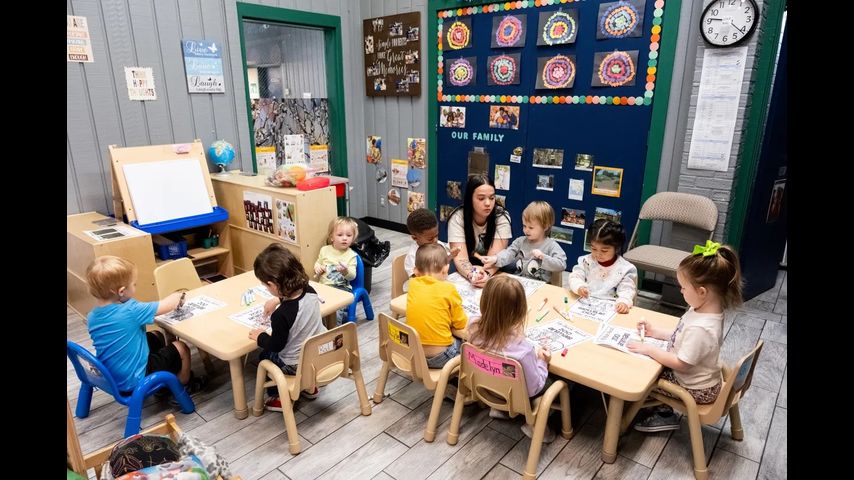
The Rising Star program sets expectations for the type of education young children receive in daycare. They’re exposed to the alphabet, language sciences, math and science earlier. Teachers are also expected to have higher qualifications and be able to build relationships with each of the children to help them teach emotional regulation and rule-following. And centers must meet certain guidelines for the quality of their facilities both indoors and outdoors. This means age-appropriate toys, learning tools, exercise equipment and more.
Children are expected to be ready for the transition to kindergarten when they graduate from a Texas Rising Star 4 program.
Kofron and many other organizations see this change as an overall benefit to the child care landscape in Texas.
Documents associated with the bill show little-to-no debate by lawmakers at the time. It passed favorably out of committees in each legislative chamber with a few amendments and tweaks. It was passed with a majority vote in the House and with five nays from state Senators.
Legislative analyses of the bill provided prior to its passage determined that the new requirements would not cost Texas anything. One analysis stated the state could rely on American Rescue Plan Act funding to cover any potential increase in cost.
Critics, however, told lawmakers that this mandate would result in cuts to the number of children being served. Federal funding is fickle and Texas doesn’t contribute enough to cover increased costs, they said.
And that’s how it played out.
The average cost per child, per month, in Texas grew from $581 in 2022 to a projected $904 in 2027, according to the Legislative Budget Board in September.
Even though lawmakers in 2025 reallocated $100 million of unused federal dollars for needy families to the subsidy program to be spent over 2026 and 2027, the Texas Workforce Commission still had to cut the number of children it serves. That one-time infusion of cash was eaten up entirely by inflation, according to Texans Care for Children, a nonprofit child advocacy organization.
So why didn’t lawmakers pay for it?
The legislative session in 2021 opened on a new presidential administration – President Joe Biden took office after a tumultuous first term by President Donald Trump. The nation was still reeling from the COVID-19 pandemic and states were receiving billions of federal dollars.
In Texas, former Texas Comptroller Glen Hegar predicted the state would suffer a $1 billion revenue shortfall due to the pandemic at the beginning of the legislative session. By April, his views changed and he instead predicted an additional $3 billion in the budget, leaving the state with $725 million in the bank.
None of that accounted for the trillions of dollars the federal government spent in stimulus packages, billions of which were directed to Texas.
The American Rescue Plan Act was cited in legislative documents related to HB 2607 as a way to pay for any increased costs associated with the bill that was passed that June.
Meeting minutes from the 2021 session showed no extensive debate among lawmakers about using state dollars to pay for HB 2607. Critics warned against relying on federal dollars, according to a synopsis in documents related to the legislation.
Kaminski told the Texas Tribune he thought relying on ARPA was going to be an issue once they ran out — which they would. Those dollars had to be allocated by 2024 and spent by the end of 2026.
When Trump was re-elected to office, a large focus in his first few months was to reduce government spending. The budget for child care services wasn’t cut, but it also didn’t receive additional funding to make up for the funding cliff as ARPA dollars ran out.
“Across the board, there has to be some mechanism of sustainable funding. I mean that's going to be key to all of it,” Kaminski said. “Without a funding mechanism, we're going to have this vicious cycle of having good intentions but not paying for what needs to be there.”
Texas has been slow to bolster its own investment in child care. The state typically meets the minimum payment to receive federal dollars and that’s it. The $100 million was a historic — but one-time — investment.
Many states across the country are also having to cut the number of children they serve. And there are states, besides Texas, who have been slow to invest in child care. Others, however, see child care as an economic investment. Florida and New Mexico, for example, recently found ways to permanently fund their own child care subsidy programs.
The reality of child care in 2026
Being a 4 Star program is the only way Katrina Smith’s centers, Just Kidz Preschool and Another Just Kidz Preschool, can stay afloat. The subsidy program helps lower the overall cost of providing child care for private-pay families in East Texas who don’t qualify for subsidies but also can’t afford a high child care bill.
Both of her programs were certified Texas Rising Star 4 before it was mandated because she wanted to provide high-quality education regardless of her families’ incomes. But it came at a cost.
Operating a 4 star center is expensive and demanding.
Teachers are often young women, many of whom have little experience, and are entrusted to manage classrooms with 10 to 15 infants and toddlers. Those classrooms are expected to meet certain standards with unannounced visits from state assessors.
“Teachers are leaving and going to Chick Fil A, making $15 an hour instead of working for me at $12 an hour, while trying to teach a 2-year-old emotional regulation when you've got five that are biting each other right now,” Smith said.
One of the biggest challenges is the financial cost of replacing broken toys and learning materials. For example, Smith has to keep the alphabet at eye-level for her 2-year-olds, the perfect height for little hands to grasp and tear apart the paper learning tool. Every day, she has to tape a ripped letter H, adorned with a little horse on it, back together.
Kids are rough on toys and she has to be ready to fix or replace them at the drop of a hat or risk an assessor docking points off her 4 Star status.
Smith wants to see two things — a steady, growing number of children receiving child care subsidies and consistent funding from the state.
“If they want quality education, regardless if it's for an infant up to a senior in high school, and they want the teacher to be able to do it, then they should be paying for it,” Smith said of the state.
Disclosure: Children at Risk and Texans Care for Children have been financial supporters of The Texas Tribune within the past five years. The Texas Tribune is a nonprofit, nonpartisan news organization that is funded in part by donations from members, foundations and corporate sponsors. Financial supporters play no role in our journalism. Find a complete list of them and more information about our financial and disclosure policies here.
This article first appeared on The Texas Tribune.
More News