Not all paths to college and career readiness pay off equally for Texas students, study finds
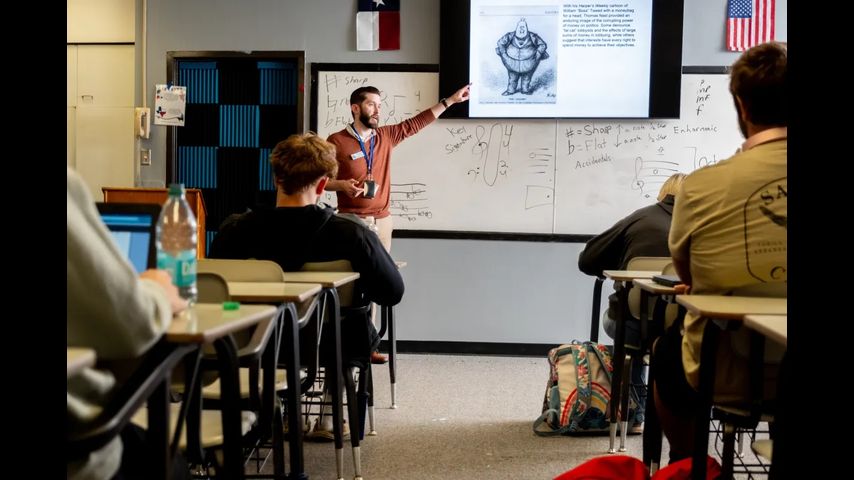
As Texas pushes more high schoolers to get ready for college and the workforce, new research suggests that some of the ways schools count students as ready don’t equally set them up for success after graduation.
The state rewards Texas school districts for preparing students for life after graduation, tying college and career readiness to more school funding and a higher school performance rating.
The Texas Education Agency has been increasingly strict on districts about college readiness. In the 2022-23 school year, state education officials raised the benchmark for schools to qualify for an A grade in the category of college and career readiness: Schools needed to get 88% of graduates ready for life after high school, up from 60% in prior years.
Researchers from four Texas universities tracked nearly 1 million Texas high school students across eight graduating classes from 2016-23 to see how they fared after high school, including the wages they earned as well as whether they enrolled in college and completed their degree.
While English and math college prep courses have seen a boom in enrollment, the researchers found students in those courses were 5% less likely to earn a college degree or certification within six years of high school graduation than students who were not considered college ready. They were also 18% less likely to get a degree or certification than their dual credit peers. The results of the study, The Uneven Promise of Readiness, suggest college prep courses offer a false signal of preparedness.
“We could be potentially setting students up for failure because we're saying, ‘OK, you're college ready.’ But you actually get into college and you're immediately taking developmental coursework,” said Jacob Kirksey, lead researcher on the study and professor at Texas Tech University. “And maybe you've racked up, you know, loans as a result of that process.”
Meanwhile, students who earned a credential in high school — be it an associate’s degree or a certificate — earned 15% to 20% more in wages later in life than students who were not college ready. Dual credit was also shown to predict a likelihood to enroll in and complete college.
The TEA has started a process to review and approve college prep classes. To date, only a handful of English prep courses have received a stamp of approval. No math college prep courses have.
Kirksey has also called for Texas lawmakers and state education officials to rethink how college and career readiness is incentivized, offering public schools bigger rewards for higher-quality pathways like dual credit, and smaller rewards for lower-quality pathways like college prep classes. His previous research on the impact of teacher certification on student achievement led the state to phase out uncertified teachers in core classes.
“College, career and military readiness should not be treated as a black and white checkbox for students and districts,” Kirksey said. “We think by making that distinction … districts will have all the incentives they need to, again, be celebrating these better pathways.”
The rise in popularity in college prep courses were a result of schools trying to respond to the stricter standards for college readiness despite limited resources, said Gabriela Sánchez-Soto, a researcher with the Houston Education Research Consortium who studies college, career and military readiness. Prep courses were appealing because school districts were able to offer them without a massive overhaul to their curricula, Sánchez-Soto said.
“You can't blame the players for playing the game,” Sánchez-Soto said. “But we need to always assess how well whatever thing we're asking students to do is actually accomplishing. … If a requirement is not fulfilling its promise, we need to do something about it.”
The Texas Tribune partners with Open Campus on higher education coverage.
Disclosure: Texas Tech University has been a financial supporter of The Texas Tribune, a nonprofit, nonpartisan news organization that is funded in part by donations from members, foundations and corporate sponsors. Financial supporters play no role in the Tribune's journalism. Find a complete list of them here.
This article first appeared on The Texas Tribune.
More News